News World
Releases
Models, APIs and products as they shipped, with what they do, what they do not do, and the link to the original announcement.
Nothing for that search in the published issues.
Releases
Issue 009 · deepseek v4.1 flash is back, under an mit license
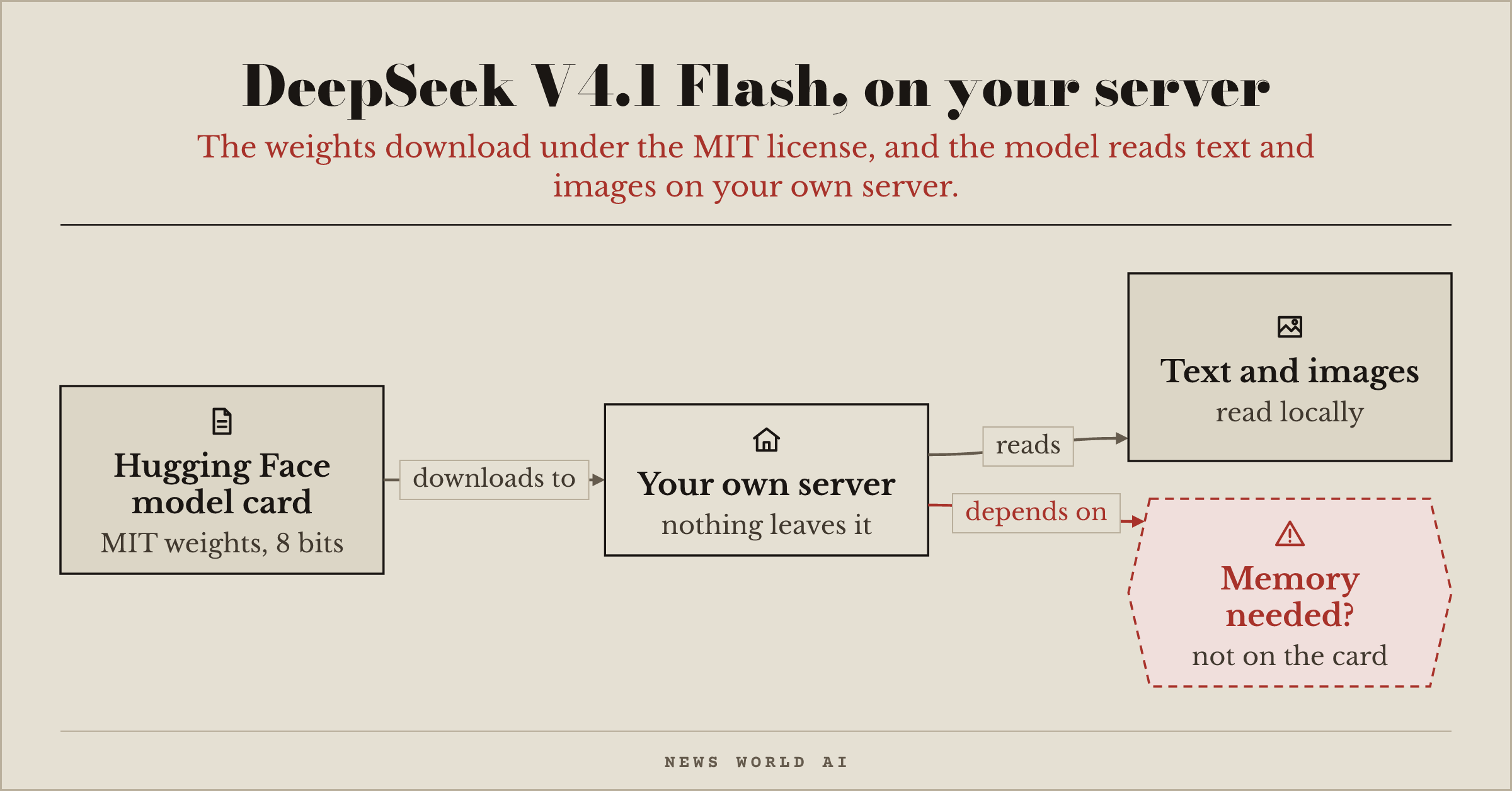
DeepSeek V4.1 Flash 1017 (DeepSeek)
27,737 downloads, 1,876 likes on Hugging Face. MIT license.
What it's for Running a fast 763 billion parameter model on your own server that also reads images, without sending anything to DeepSeek. The weights (the model's file) download in a lighter 8 bit version, according to their tags, and the MIT license asks almost nothing of you. DeepSeek calls it a minor update to the version covered in issue 004: reasoning, coding, agent tasks and images improve (42.6 against 36.8 on the HLE test without tools). Uploaded to Hugging Face on October 17, it comes out the week when an order from the US Department of Homeland Security, published in the Federal Register on October 20, removes DeepSeek products, and other companies' products built with its technology, from civilian federal agencies.
The limit The model card does not state the memory needed, and offers no smaller version.
LFM2.5-24B-A2B (Liquid AI)
Liquid AI's post: 288 points and 81 comments on Hacker News. GGUF version (the format read by llama.cpp, LM Studio and Ollama): 132,848 downloads on Hugging Face.
What it's for Running a fast agent on your own device, without a data center graphics card. The model has 24 billion parameters (the settings it has learned), but only 2 billion work on each word: each time, it wakes up only a few specialists among its own (this is called a mixture of experts). In issue 007, Liquid AI released d1, its decision models for devices: the lab is sticking to the same line, device first.
The limit Publisher's benchmarks and speeds only, no independent measurement. No standard license: a license specific to LFM models, whose commercial terms the post does not summarize.
Nemotron 3.5 Super VL (NVIDIA)
11,459 downloads, 186 likes for the NVFP4 version on Hugging Face.
What it's for Handing an agent tasks that mix text, images and video: understanding a document, searching, using tools, coding. It is an open model with 120 billion parameters, 12 billion of which work on each word. Its weights are published in several formats, including NVFP4, a lighter 4 bit version, under the OpenMDW 1.1 license, which allows commercial use.
The limit The model card states neither Mac support (Linux only) nor the total memory needed.
Sphinx
On Hacker News: 252 points, 89 comments.
What it's for Only shipping code you have understood. Before you push what your AI wrote, a hook (a small check that fires at that moment) quizzes you on that code. In issue 008, our hook refused a change; Sphinx questions the person.
The limit Sphinx has no service of its own: the changed code goes to the provider of the reviewer model you choose (.env files and keys are left out).
Llmspeed
On Hacker News: 329 points, 86 comments.
What it's for Getting a feel, before you buy a machine, for how fast a local model would answer on it. Useful in the week RTX Spark laptops reach the shops (see In brief).
The limit These are not measurements made by the site: some come from community benchmarks, the rest is extrapolated; nothing on the quality of the answers.
Exa 3.0
Announced by Exa on October 19.
What it's for Giving your agent a search engine built for it, which serves it the useful passages of pages. In this version, Exa promises richer data at no extra charge, and a cheaper Lite plan. Useful as websites close their doors to agents (see Worth reading).
The limit The promises are the publisher's, with no independent benchmark. No version to host yourself: every query goes through Exa's API.
Issue 008 · windows gets its box for agents
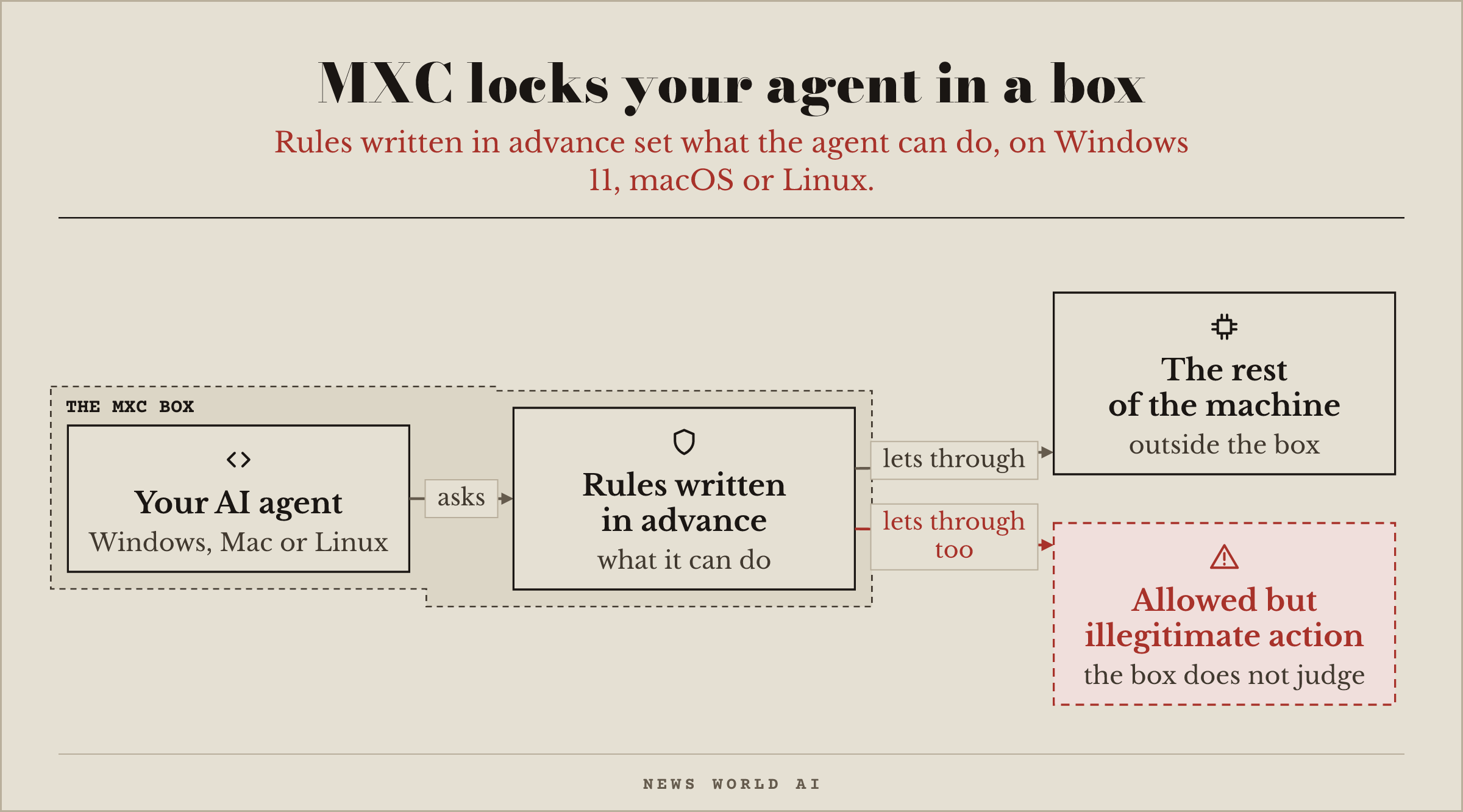
Microsoft Execution Containers, or MXC (Microsoft)
Announced on October 7 on the Windows Developer blog; version 1.0.0 was released the same day on its GitHub repository. On Hacker News: 227 points, 69 comments.
What it's for Running an AI agent locked inside a box: rules written in advance set what it is allowed to do. MXC runs on Windows 11, macOS and Linux.
The limit Two of the four boxes in Microsoft's post exist only on Windows 11, and no independent test has been published. Like any box, it limits what the agent can do; it does not judge whether an allowed action is legitimate.
blogs.windows.com/windowsdeveloper/…
DuckDB's agent mode
Free: DuckDB is open source software. DuckDB's own benchmark: 132 runs, all correct.
What it's for Having an agent analyze your data files. DuckDB, the program that queries your CSV and Parquet files on your own machine (two common formats for data tables), gets an agent mode that changes what its command line sends back to the model; the -no-agent option brings back the usual display. DuckDB had Claude Code answer the 22 questions of the TPC-H benchmark in plain language, without SQL (the language of databases), each one three times with agent mode and three times without. All 132 answers are correct, with or without the mode. With it, the DuckDB output read by the model drops from about 123,600 to 50,800 tokens (the pieces of words models work with), 59% less. But the saving shows neither in the total cost nor in the time taken: it is about 0.5% of everything the model reads, and the runs with the mode took slightly more back and forth (237 turns against 224). Here the tool adapts to the agent, and it is the third issue in a row where DuckDB appears.
The limit No independent measurement has been published: a single benchmark (TPC-H), a single agent (Claude Code). The mode helps the agent read the results; it does not check that the question was understood correctly.
Talorys
On Hacker News: 328 points, 155 comments.
What it's for Having a personal agent without leaving a machine running at home: you install it yourself on your own Cloudflare account, on its free plan, with a single command. It keeps your tasks, notes, projects and reminders, and remembers what you tell it. Another route: Xiryn (more than 130 stars, MIT, created October 11) gives each agent its own Linux desktop on your computer, in Docker (a tool that runs programs in closed spaces), with your keys and an encrypted vault. On the same Cloudflare free plan, docflare-ai (41 stars, MIT) installs an assistant that answers questions about your documentation, with a single line to paste into your site.
The limit On the free plan, it only chats within the daily allocation of Workers AI, Cloudflare's model service: once that is used up, chat stops until the daily reset, everything else keeps working, and it never turns on a paid option by itself. Its description sets up no link to your email, your calendar or your payments.
BetterWispr
On Hacker News: 212 points, 126 comments. Free and open source, by its own description.
What it's for Dictating long instructions to your agent instead of typing them, on a Mac. Developer Simon Willison describes building a page of his blog almost entirely by voice, talking to Codex while he cooked dinner. BetterWispr's built-in models transcribe your voice on the Mac, with no account and no fallback to an online service; an online service is only used if you pick one. On iPhone, OpenWhispr is free to install and transcribes on the phone, with no account and no limit (a paid Pro plan exists alongside).
The limit Mac only (macOS 14 or later): no Windows or iPhone version.
Issue 007 · decision models you can download
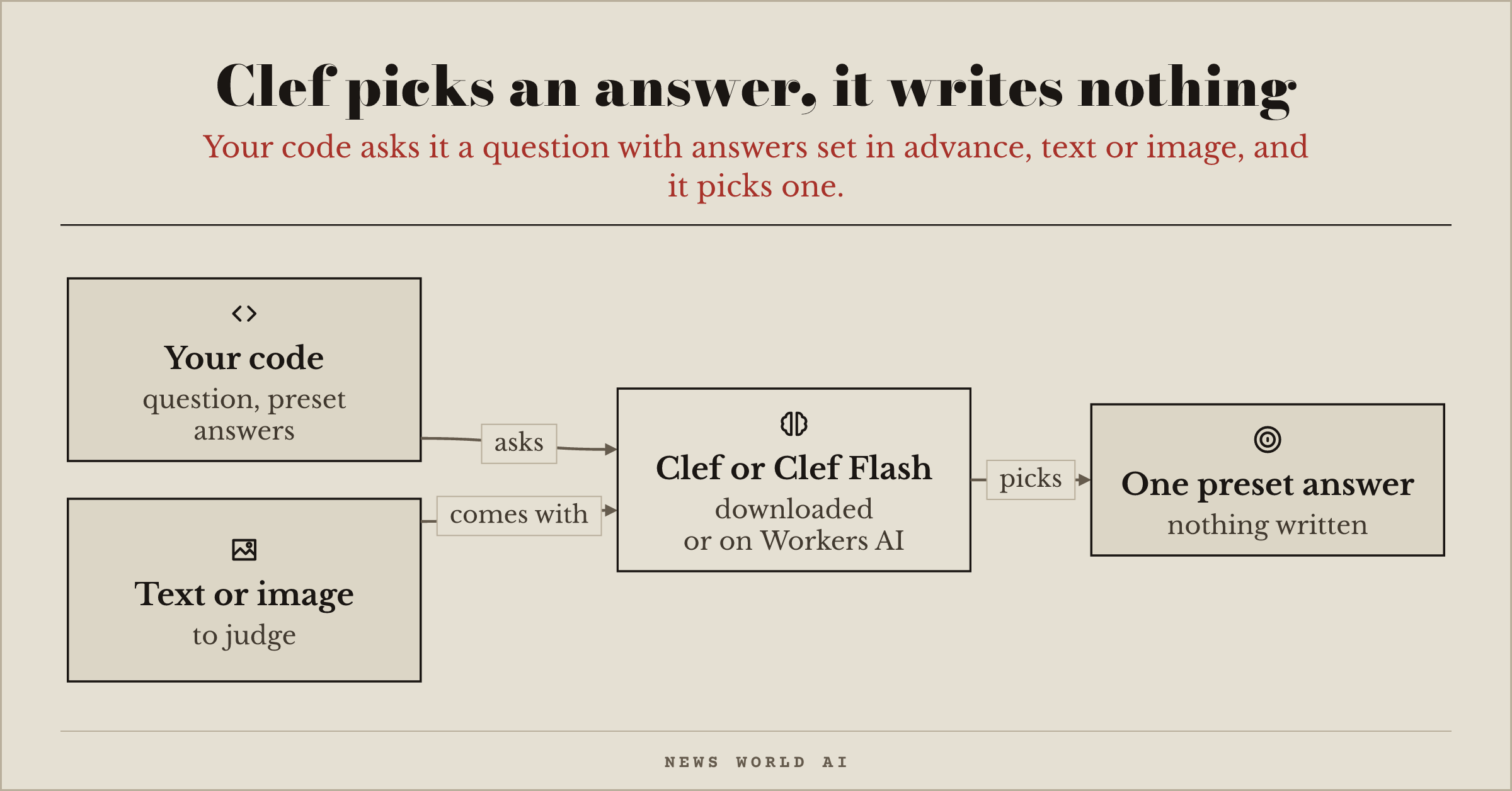
Clef and Clef Flash (Cloudflare)
Clef (27 billion parameters): 10,874 downloads, 1,872 likes. Clef Flash (9 billion): 17,587 downloads, 685 likes (Hugging Face). Apache 2.0 license.
What it's for An agent's small decisions (routing a request, sorting a message). Like Jev, they pick an answer set in advance without writing anything, and Cloudflare says they are compatible with Jev's API; unlike Jev, they also read images. Cloudflare also serves them online, on Workers AI. On October 7, Liquid AI published d1, open decision models for text and images, built to run on the device.
The limit No independent measurement has been published: the scores are Cloudflare's own. Fine-tuning on your data is not self-serve: at first it goes through Cloudflare's engineers.
EmbeddingGemma 2 (Google)
21,148 downloads, 1,147 likes on Hugging Face. Apache 2.0 license, 740 million parameters, more than 100 languages.
What it's for Searching your own documents. Announced by Google on October 6, the model turns a text, an image, a sound or a video into a series of numbers, and two similar pieces of content get close numbers: that is the basis of an agent that finds the right page in your archives. Unsloth publishes a GGUF version, the format of llama.cpp, the program that runs models at home. A model of this kind is worth keeping on your own machine: if it disappears, every number already stored has to be computed again.
The limit It does not answer questions, it is for searching and sorting.
Claude for Google Workspace (Anthropic)
An add-on for Google Docs, Sheets and Slides, announced on October 6, in beta on all paid Claude plans (Pro, Max, Team and Enterprise).
What it's for Drafting, analyzing a spreadsheet or building a presentation with Claude, right inside your Google documents, without copying and pasting from one tab to another. For people who build without being engineers, it is the assistant installed where their documents already live.
The limit It works only on the file it is opened in, plus the connectors you turn on: it does not ask for access to your Drive, Gmail or calendar (see The security reflex). It does not work in Firefox, does not accept an API key (you need a Claude account), and no list of countries is given.
Pi pod
Shown on Hacker News: 121 points, 47 comments. Page signed Evan, code under the AGPL-3.0 license owned by the company Billzo, LLC.
What it's for Running pi, a minimalist coding agent, in sandboxes (closed spaces) on your own server rather than on your machine. You need a Linux server with 8 GB of memory and Docker, a tool that runs programs in closed spaces. Around pi, open-instinct (253 stars, MIT), a personal agent you control through iMessage, says it builds on it.
The limit It has no hosted offering yet: one is announced as coming soon. The project says it is built around pi, but no connection to the pi team is established.
Parseable
Shown on Hacker News: 86 points, 24 comments. Open version free under AGPLv3, which requires you to publish your changes if you turn it into an online service. Hosted offering at $0.39 per GB of data received (14-day free trial), Enterprise from $15,000 a year.
What it's for Keeping a record of what your agents did. Parseable stores logs, metrics and traces in OpenTelemetry format (the standard for exchanging traces) in a single program (210 to 218 MB for a Linux server), to install on your server, or to use through its hosted offering. When an agent fails, the only useful question is what it saw and decided at each turn: without traces, you are searching blind.
The limit The open version does not have what the Enterprise offering adds: custom data partitioning, one installation shared by several customers, a log of who did what, a choice of the country where the data stays, dedicated support.
Issue 006 · two open answers to jev's idea
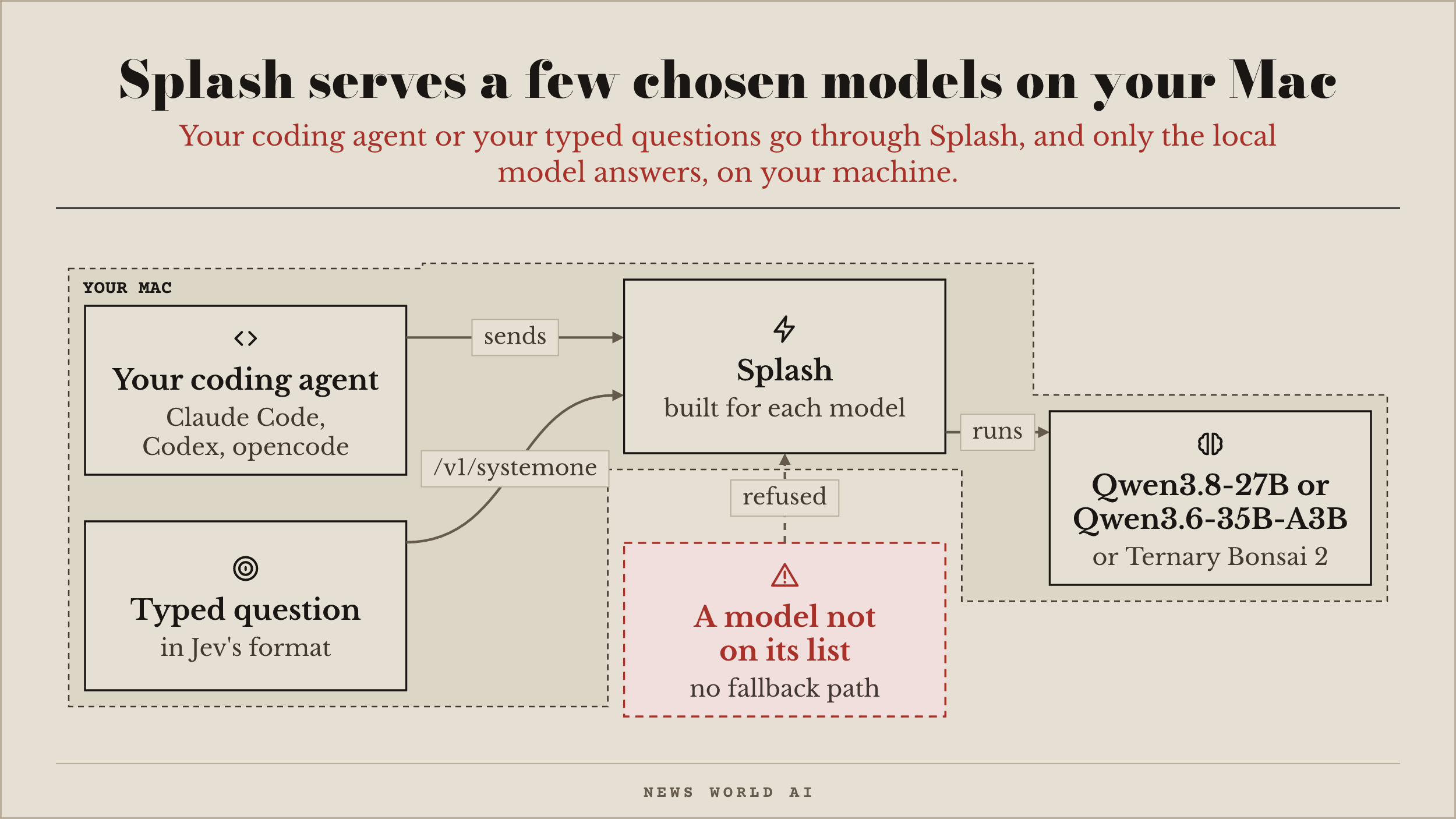
Splash (Inco AI)
Repository ★ 967, Apache-2.0, last commit on September 28, 2026.
What it's for Running a coding agent on a model that lives on your Mac: splash claude, splash codex or splash opencode starts it already wired up. At /v1/systemone, it also accepts typed questions in Jev's format through TypeSafe's official kit: Qwen answers them, locally, not Jev. It is built for two families of Qwen models, Qwen3.8-27B and Qwen3.6-35B-A3B (17.4 and 20.9 GB downloads), and also accepts Prism ML's Ternary Bonsai 2. According to Inco AI, on a 48 GB M5 Pro Mac with coding requests, the 27B writes a short answer at 74 tokens per second (a token is a piece of a word), twice as fast as the quickest of the other engines measured, and 1.2 times when reading a long fresh text (32,000 tokens). It needs an M3 Mac or newer, macOS 26.4 and 36 GB of memory, 24 GB with smaller versions.
The limit It only runs the models on its list. The benchmarks are Inco AI's own, on a single machine, with no independent measurement published. And the confidence /v1/systemone returns is not calibrated, the repository says: it is the naive reading whose flaws AnyJev measures.
Qwen3.8 27B (Qwen)
6,844,348 downloads, 16,510 likes on Hugging Face, Apache-2.0.
What it's for An open model that reads text and images, runs on your own machine without sending anything out, and whose license allows use in a commercial product. For an ordinary computer, ISTA publishes a compressed version in GGUF format (the llama.cpp format), downloaded 1,655,818 times. On a Mac, it is also one of the models Splash serves.
The limit The compressed version does not match the original everywhere. According to ISTA, its IQ3_S variant (11.8 GB instead of 53.8 GB) equals the original model on a math test (AIME25) and a coding test (LiveCodeBench v6), but loses 0.51 points on a science test (GPQA-Diamond).
GPT-6 Sol and Luna (OpenAI)
OpenAI's two faster, cheaper GPT-6 models, alongside Astra.
What it's for The work you already hand to OpenAI's models. Per million tokens, Sol costs $2 for input and $10 for output, Luna $0.10 and $0.50. According to OpenAI, Sol makes about half as many mistakes as its predecessor on its internal factuality test.
The limit Price and capabilities are OpenAI's claims alone: no independent benchmark confirms them yet.
MiMo V2.6 Pro RL (Xiaomi)
76,518 downloads, 587 likes on Hugging Face, MIT license.
What it's for Running an agent that understands text, images, video and audio, on a model whose weights Xiaomi publishes under a license that allows commercial use. There is also a lighter Flash version (309 billion parameters, 28,842 downloads). A plugin promising this model "free and unlimited", with no key and no account, is circulating on GitHub: the model is downloaded from Xiaomi, nowhere else.
The limit It is not a model for an ordinary computer: 1,020 billion parameters in total, 42 billion of which work on each word. The scores on its model card are published by Xiaomi.
Issue 005 · jev ticks a box, your code decides
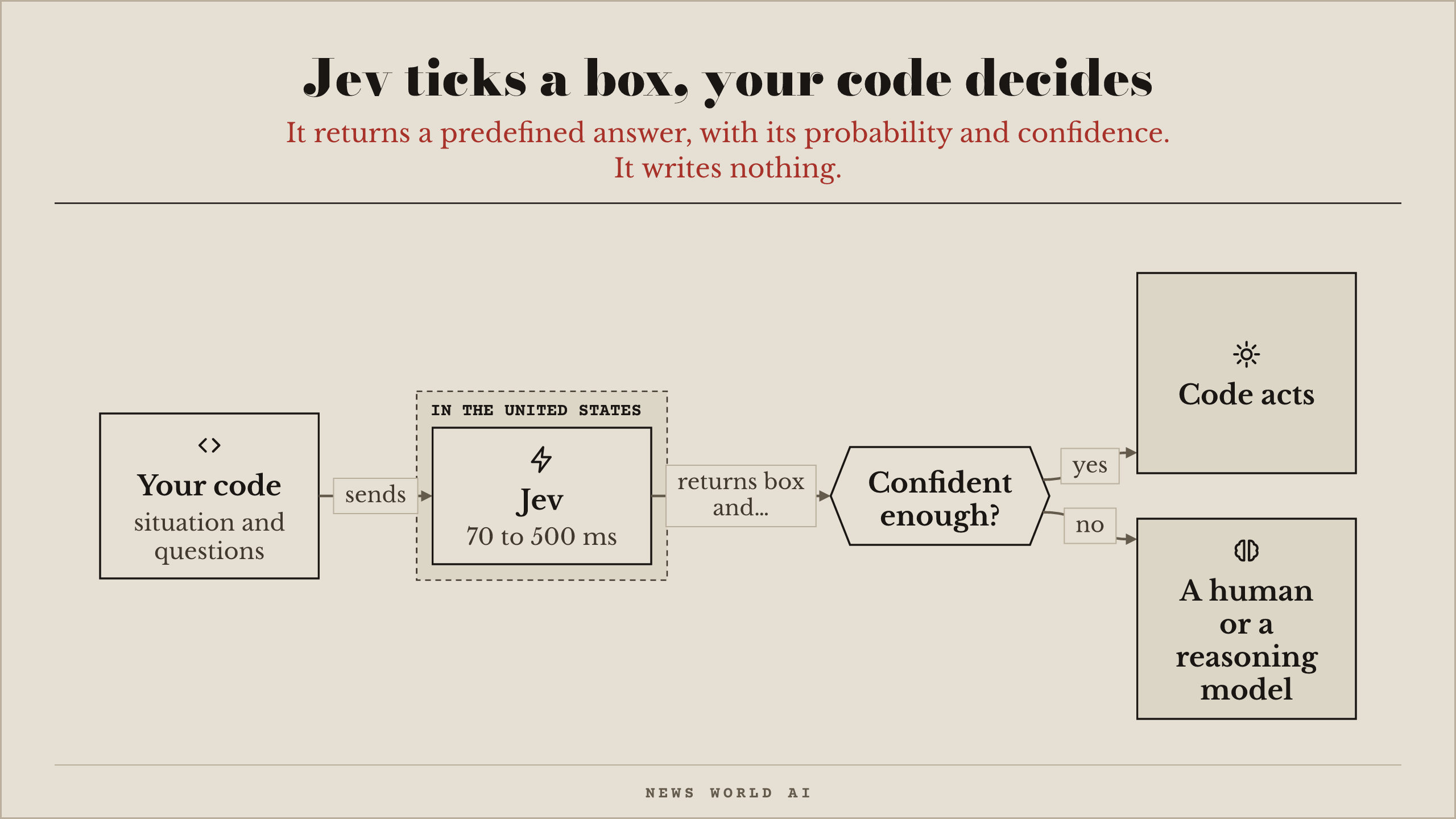
Jev (TypeSafe AI)
Through TypeSafe's API, in early access. Weights not published.
What it's for An agent's small decisions: routing a request, sorting content, deciding whether a message is acceptable, filtering before paying for a large model. Jev generates nothing. Your code sends it a situation and questions whose answers are fixed in advance: an option from a list (255 at most), a place on a scale, or yes or no. It returns the answer, a probability for each option, and a confidence score. On its own benchmarks, Jev matches Sonnet 5 (67.8% agreement with the reference), falls short of Opus 5 (73.1%), and responds in 0.4 seconds. TypeSafe writes that its gains (193.6 times faster and 444.6 times cheaper on its test workflows) are on the high end of what real-world use will yield. Price: $0.042 per million input tokens (a token is a piece of a word), and output is free.
The limit Its tests were written by its team, which acknowledges possible bias (one external trial is in "Worth reading"). "No hallucination" is a construction, not a measurement: the answer always lands in a predefined box, but Jev can tick the wrong one. It writes nothing. Access is waitlisted. Everything goes to the United States (latency measured from the West Coast; the trip from elsewhere adds up), where TypeSafe commits to not training models on what you send. It writes that it cannot prove its pricing is not subsidized.
Ternary Bonsai 2 27B
2,569,604 downloads, 1,840 likes on Hugging Face. Downloadable GGUF file (the model format used by llama.cpp).
What it's for Running a 27-billion-parameter model on an ordinary computer, without sending anything out. Ternary Bonsai reduces each parameter to three possible values (1.72 bits on average): the file weighs 5.95 GB, versus 53.8 GB for the reference version, about 9.3 times smaller according to the model card. It needs the publisher's modified version of llama.cpp (the standard version rejects these files), and a separate version exists for MLX (on Apple silicon Macs).
The limit The publisher says the model keeps 98.2% of the reference version's capabilities: that is its own measurement, and the model card cites no independent one.
Cactus Needle 3
Downloadable models. 8 to 29 MB.
What it's for Automating structured tasks (calling the right tool with the right settings, or pulling the fields of an invoice, a booking, or a form out of messy text) with a file of 8 to 29 megabytes, where an ordinary language model weighs gigabytes. Cactus Compute claims its 4L variant matches DeepSeek V4 Flash on these tasks, once tuned on the target task.
The limit The claimed parity with V4 Flash is measured only by the vendor, and it applies only to the tuned 4L variant.
Issue 004 · knowing what the agent did
DeepSeek V4.1-Flash
288,414 downloads, 2,525 likes on Hugging Face. MIT license.
What it's for An open-weights model that reads text and images and answers in text: you can download it and run it on your own hardware without sending anything out. Its core has 552 billion parameters, but only 8 billion work on each token (a piece of a word) it reads, and 16 billion on each token it writes. Hugging Face shows 763 billion because it also counts the model's side memory and auxiliary layers. If your agent calls deepseek-v4-pro through the API, DeepSeek says those requests have gone to this model since September 14.
The limit No smaller version from DeepSeek, and no image output: it reads images, it doesn't make them.
Edge0-35B-A3B-preview
8,109 downloads, 2,233 likes on Hugging Face. Apache 2.0 license.
What it's for Run a 35-billion-parameter model on an Apple Silicon Mac in under 3 GB of active memory, without sending anything out. The model stays on disk, and only the parts needed at each moment are loaded. It isn't a new model: it's a compressed Qwen3.6-35B-A3B with adapters on top.
The limit No research paper, no named authors, no independent benchmark.
Cognition SWE-2
In Devin Desktop and the command line. Weights not released.
What it's for Hand programming tasks to Devin, Cognition's coding agent, running Cognition's new in-house model, built from Kimi K3. On FrontierCode, a benchmark written by Cognition, it lands within one point of Fable 5.1 at a 64% lower cost per task. The next day, OpenAI described how Devin checks its own work with GPT-6 Astra.
The limit No downloadable weights, no independent benchmark.
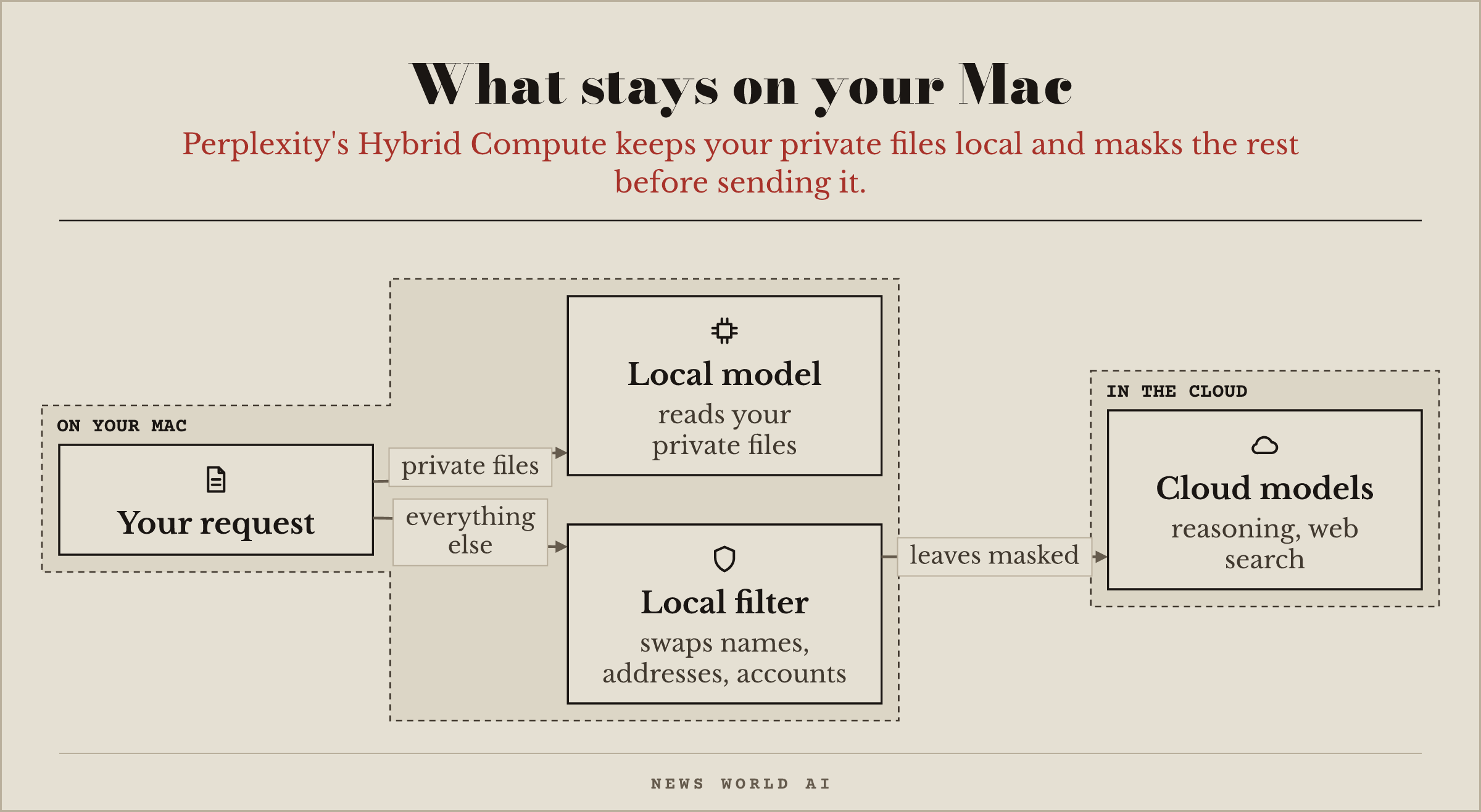
Perplexity Hybrid Compute
For Pro, Max and Enterprise subscribers, on an Apple Silicon Mac with at least 24 GB of memory.
What it's for Split an assistant's work between the cloud (reasoning, web search) and your Mac (your private files). Before anything leaves, a filter running on the Mac swaps names, addresses and account numbers for stand-ins. On September 14, NVIDIA announced Perplexity Portable Computer for Windows PCs with an RTX card of at least 24 GB, with the option to hand work off to cloud models.
The limit No kit or programming interface to reproduce this split in your own tools.
Issue 003 · what your coding agent sends home
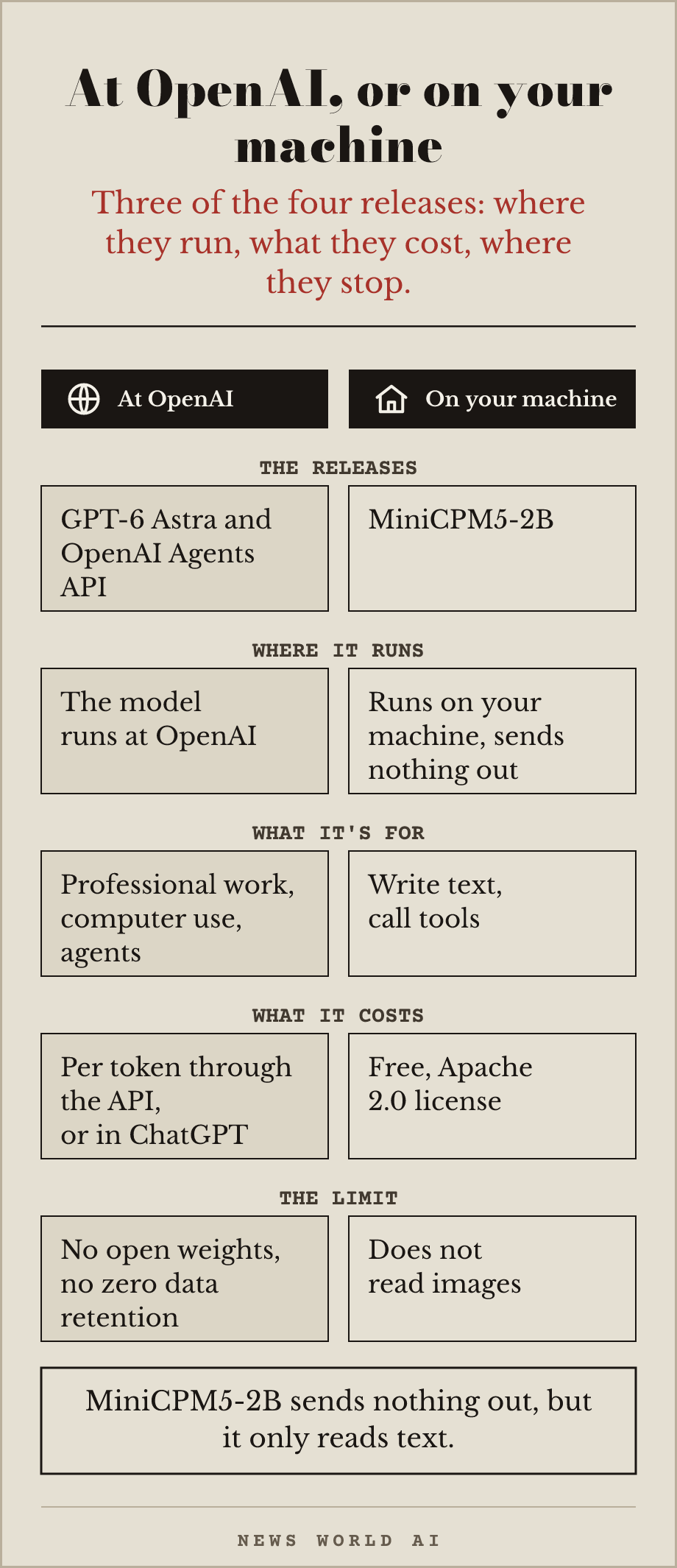
GPT-6 Astra
In ChatGPT Work, in Codex and through the API, from $10 per million input tokens and $50 per million output tokens.
What it's for What OpenAI presents as its most capable model, aimed at professional work: computer use, web browsing, software engineering, cybersecurity, science. On September 8, OpenAI published a proof that it says settles the Navier-Stokes problem (the equations that describe how fluids flow), one of the seven Millennium Prize Problems. It comes from an unreleased internal model that OpenAI says is significantly more capable than GPT-6 Astra. Mathematician Tristan Buckmaster (NYU), who was working on the same approach, disputes OpenAI's account of how the effort started.
The limit No open weights, no version you can host yourself.
OpenAI Agents API
In public beta since September 10. No extra fee: model tokens and tools at standard API rates, plus container time if OpenAI hosts the workspace.
What it's for Build agents whose engine (the loop that moves the agent forward and keeps its session) runs at OpenAI, with a workspace hosted by OpenAI, by a partner or on your own machines, sessions that last several days, tools, and subagents working in parallel. The engine is the one behind Codex (OpenAI's coding agent). Released the same day as GPT-Live-1 in the API, which listens and speaks at the same time.
The limit No zero data retention, no data residency outside the United States.
Suno v6
v6-mini for everyone, v6 and v6-wild for Pro and Premier subscribers.
What it's for Generate music from a text description, to add a soundtrack to content produced by your agent (video, podcast, presentation). A new generation of models developed with industry partners including Warner Music Group, BMG and Believe; older models will be retired. The next day, ElevenLabs and Universal Music Group announced a licensed platform, still in development, where fans will be able to remix tracks by participating artists.
The limit No v6 or v6-wild on the free plan, only v6-mini.
MiniCPM5-2B
42,289 downloads, 1,135 likes on Hugging Face. Apache 2.0 license.
What it's for Write text and call tools with a 2.5-billion-parameter model that runs on your machine without sending anything out. Official lighter builds exist for llama.cpp, Ollama, LM Studio and Macs (MLX).
The limit Does not read images, and no more than 131,072 tokens at a time.
Issue 002 · A newsroom with no journalists
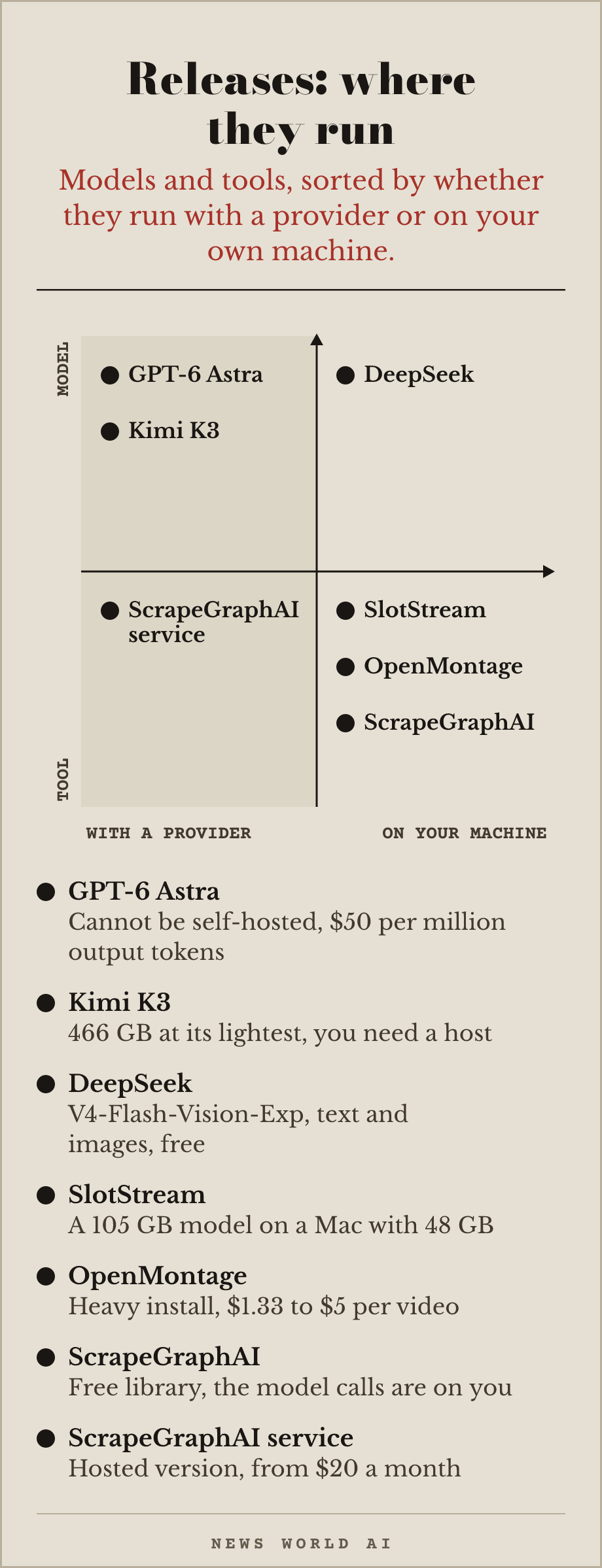
GPT-6 Astra
$10 per million input tokens, $50 per million output tokens. Rolling out across ChatGPT Plus, Pro, Business, Enterprise and the OpenAI API.
What it's for Programming, cybersecurity, scientific research, computer control. It is the first model to cross the "critical" threshold of OpenAI's preparedness framework in cybersecurity, meaning it can attack as well as defend. A fast mode doubles the speed, and doubles the price.
The limit The rollout is not finished, not everyone has it yet. And it is a model you cannot host yourself: output runs at $50 per million tokens, where Google's Flash range sits at $3.75.
Gemini 3.8 Flash (and Cyber)
Google's latest Flash model, aimed at agents, reasoning and cybersecurity.
What it's for Running agents and reasoning at the lowest cost in the Google lineup. The Cyber variant is reserved for defence teams invited by Google.
The limit Flash Cyber is not publicly available, it is reserved for defence teams. The price appears nowhere on the announcement page.
DeepSeek-V4-Flash-Vision-Exp
184,542 downloads, 695 likes on Hugging Face. MIT licence.
What it's for Reading text and images, for free, with weights you host yourself. Useful for powering an agent that needs to understand screenshots or scanned documents.
The limit Experimental build (it says so in the name). No technical paper spotted.
SlotStream
227 points and 114 comments on Hacker News, number one on Show HN on 1 September 2026. Open source, MIT licence.
What it's for Running a large model (Qwen3.8-Flash-Next, 105 GB) on a Mac with 48 GB of memory, at roughly 12 tokens per second, without sending anything outside.
The limit macOS only, with enough unified memory. 12 tokens per second is fine for asking questions, not for processing volume.
OpenMontage
56,292 stars, 7,065 forks on GitHub. AGPL-3.0 licence (strong copyleft: if you expose a service built on it over a network, you must publish your modifications). No official release published.
What it's for You describe the video you want, and the tool chains search, script, images, voice, music, editing and rendering on its own. 12 pipelines available, including Clip Factory, which cuts one long source into a batch of ranked short clips. The project's demos are priced between $1.33 and $5 per video, with a default cap at $10.
The limit Heavy install (Python, Node, Remotion). No ready-to-run release.
Watch out for the lookalike. The repo OpenMontage-app/OpenMontage (1 star, created 27 August 2026) copies the real project's description word for word without being a fork, and replaces the AGPL with an MIT licence. Do not confuse the two.
ScrapeGraphAI
30,601 stars, 3,057 forks on GitHub. Version 2.2.2, MIT licence. Python 3.12 minimum.
What it's for You give it a page address and a sentence describing what you want out of it. A model reads the page and hands back structured data. The library is free, the model calls are on you. The hosted service starts at $20 a month.
The limit Does not read RSS feeds or X. JavaScript rendering is on you (Playwright to install). Supported sources are websites and local documents.
Kimi K3
2,552,594 downloads, 11,209 likes on Hugging Face. 8,710 stars on GitHub. House "Kimi K3" licence, open weights with conditions (above $20 million in revenue from reselling inference, you need an agreement with Moonshot AI).
What it's for Understanding text and images, and swallowing a 1,048,576-token window at once, roughly three quarters of a million words. Useful for summarising very large documents or feeding an agent that needs to read a lot. Text now reads through llama.cpp.
The limit It is not meant to run on your machine. The smallest light build weighs 466 GB, the others go up to 594, 861 and 1,509 GB. Vision is not yet supported by llama.cpp, only text is.
huggingface.co/moonshotai/Kimi-K3
Issue 000 · Your agent succeeds one time in three
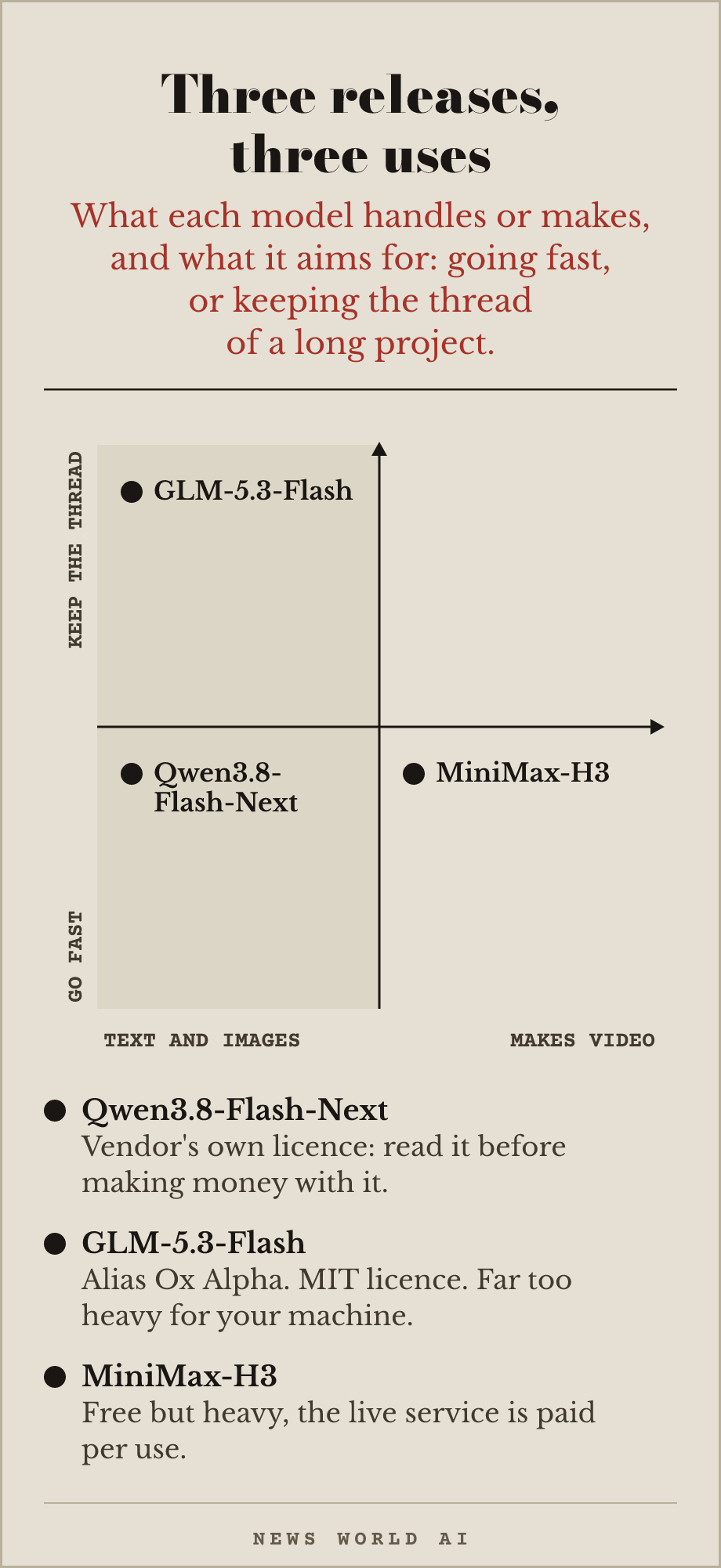
Qwen3.8-Flash-Next
What it's for the small tasks you run a thousand times a day, where every second and every cent counts, and reading images alongside text.
The counters 208,000 downloads, 4,580 likes, plus 431,000 downloads of the light build.
The limit the licence is the vendor's own, not Apache: read it before you make money with it. No image generation.
→ huggingface.co/Qwen/Qwen3.8-Flash-Next, and unsloth/Qwen3.8-Flash-Next-GGUF for the build that runs on your own machine, with nothing leaving it.
GLM-5.3-Flash, alias Ox Alpha
The story of the week. A model with no vendor name appeared on OpenRouter, free, under the handle Ox Alpha, and started beating the best on the leaderboards. Public detective work, tokenizer analysis, online betting. Then the Chinese lab Z.ai confirmed it itself: this was its GLM-5.3-Flash, put there as a full-scale live test to collect real usage before the announcement. The weights are now downloadable.
What it's for carrying a long project without losing the thread, with text and images mixed. Sparse architecture, 320 billion parameters of which only 18 work on each word: that is what makes it cheap to run.
The counters 441,348 downloads last month, 1,930 likes, MIT licence, 300,000 words of context.
The limit nobody has tested it independently since it was unmasked, and it is far too heavy to run on your machine: you go through a hosted service.
→ huggingface.co/zai-org/GLM-5.3-Flash, and Z.ai's own announcement lifting the pseudonym.
MiniMax-H3, video faster than real time
What it's for turning a sentence or a picture into video, without the wait.
The counters 5.5 million downloads of the open weights.
The limit the model is free but heavy, and the service that streams it live is paid per use.
The archive reproduces each issue as it went out, without rewriting it. A repo's stars, prices and last-commit dates are those of the day of the check, not today's: follow the link for the current state.
Geneva, Switzerland. Write to hello@newsworldai.xyz.