News World
The problem of the week
The problem of the week
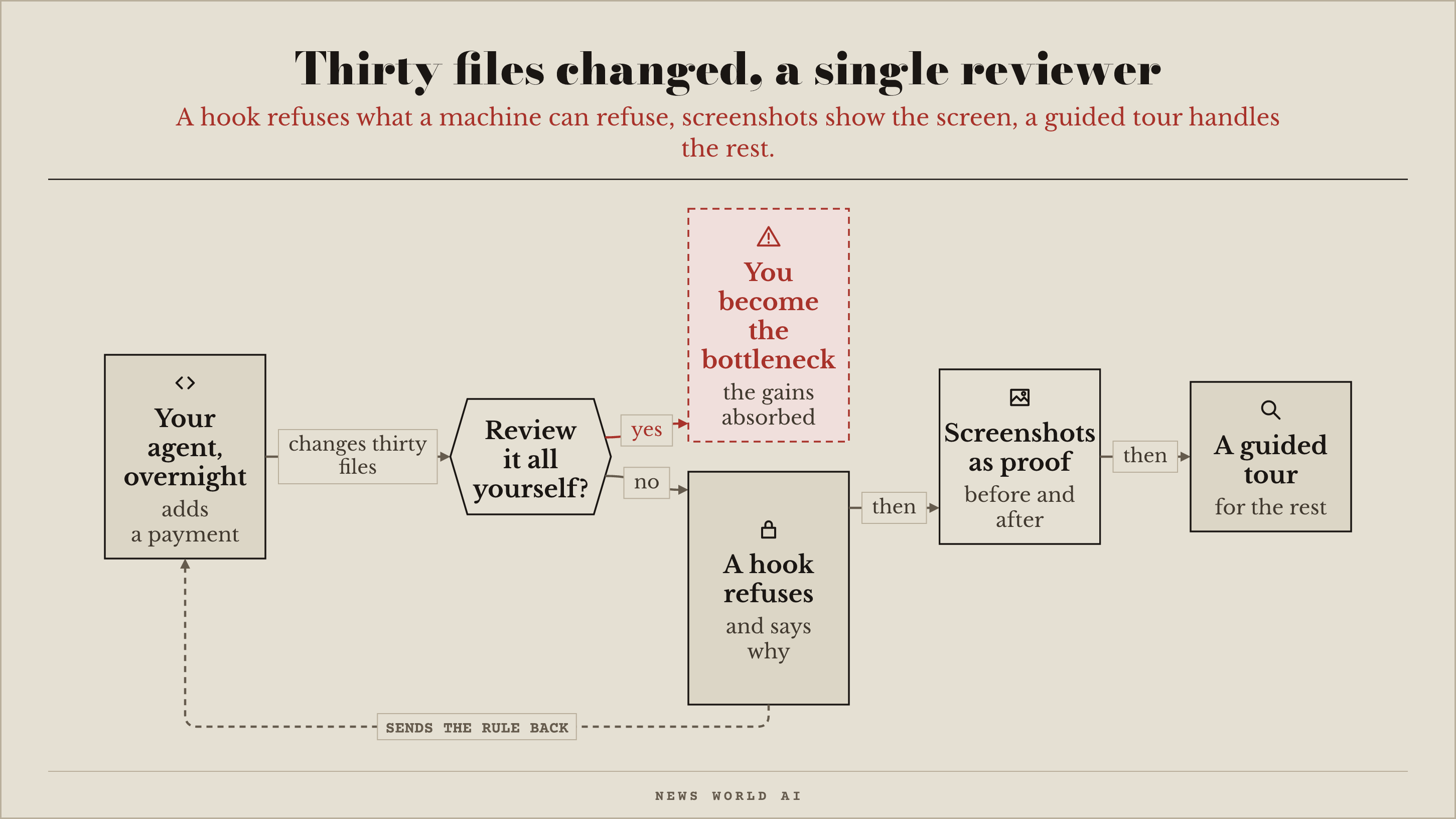
My agent writes more code than I can review: how do I avoid becoming the bottleneck?
In the evening, you ask your agent to add a payment page. In the morning, thirty files have changed, and their line by line listing (the diff) means nothing to you. According to a study reported by Ars Technica (see Worth reading), the gains from coding agents are "absorbed" by this human review. The way out: only review yourself what no machine can check.
First step, stop reviewing what a machine can refuse. Geoffrey Huntley, quoted by Simon Willison on October 13, finds that fixing AGENTS.md, the rules file the agent reads, leaves a gap, which drifts. Instead, he writes a pre-commit hook: a small check that reads the changes before they are saved, refuses the ones that break the rule and sends the instruction back to the agent. In his words: "ten out of ten". For our page, the hook refuses any API key in the code and any change to the payment code without a test. The Copilot instructions that GitHub describes guide the agent; the hook refuses.
Second step, ask for proof you can read, rather than code. claude-show-your-work (169 stars, MIT, created October 8) has Claude Code display, in the terminal, screenshots, browsing recordings made with Playwright (a tool that drives a browser) and before and after comparisons. It requires macOS and the Ghostty terminal (its description also mentions kitty). For our payment page: a screenshot of the form before, and one after.
Third step, for what is left to read, a guided tour. diff-tour (116 stars, MIT, created October 10) turns a change into a walkthrough, in the order an experienced engineer would read it, without modifying anything. Keep your own review for the points of no return only: paying, deleting data, sending. For our page, that is the part where the money goes out.
Write a pre-commit hook that refuses a commit containing an API key, or touching the payment code without a test, and that tells you why when it refuses; then show me, with screenshots, what changed on screen.
What this does not fix: a hook only catches what you wrote down, and a screenshot shows the screen, not what happens to your data.
diff-tour to read a change in order, claude-show-your-work to see the result on screen without reading the code.
Get the newsletter
Every Tuesday, in four minutes: what shipped in AI and what you can actually try the same day.
Double opt-in by email. One-click unsubscribe, link in plain sight in every issue.
Geneva, Switzerland. Write to hello@newsworldai.xyz.